B2B pricing is the process of setting prices for products sold between businesses. The 4 core models are cost-plus, value-based, competition-based, and dynamic pricing. Companies with continual price optimization see exponential revenue growth vs. yearly reviews.
Last Refreshed: March 2026 with updated statistics and tool information.
B2B pricing is the strategic process of setting prices for products or services sold between businesses, using models like cost-plus, value-based, competition-based, or dynamic pricing to maximize revenue and market share.
From Thomas Cornelius, Founder & CEO, graph8: “Most B2B companies treat pricing as a finance problem — but it’s a GTM problem. Your price signals your market position, shapes buyer psychology, and determines which segments you can access at all. Get it wrong and your pipeline suffers before the first call is made.”
Getting your pricing strategy right is the lifeblood of company profitability. An in-depth understanding of your customer and their reasons for choosing your product will guide your pricing and inform your marketing.
Pricing does not just determine the income from customer spend but also from investors, shareholders, and stakeholders. After all, the key to any viable B2B pricing strategy profiles your ideal customer alongside a detailed justification of their willingness to spend on your product.
In this guide to B2B pricing, we’ll consider some fundamental pricing strategies, look at top pricing models, and provide tips on how to choose the right ones for your business.
Why Is it Important to Get B2B Pricing Right?
There are many kinds of strategy to determine the price of proprietary products or services. The truth is, getting the pricing strategy wrong can set company revenue dangerously off course. Either a business woefully underestimates the value of their wares and misses out on extra income, or sets the stakes too high and loses out to the competition.
An alarmingly high number of businesses actually do not give their pricing strategy the time of day. It can be tempting to focus on ways to increase your process efficiency, customer acquisition and service delivery itself. Pricing can fall by the wayside because the responsibility does not clearly fall to one department or individual. Yet its critical importance to the balance sheet bottom line cannot be overlooked.
Consider this graph that displays the difference in revenue growth based on pricing strategies:
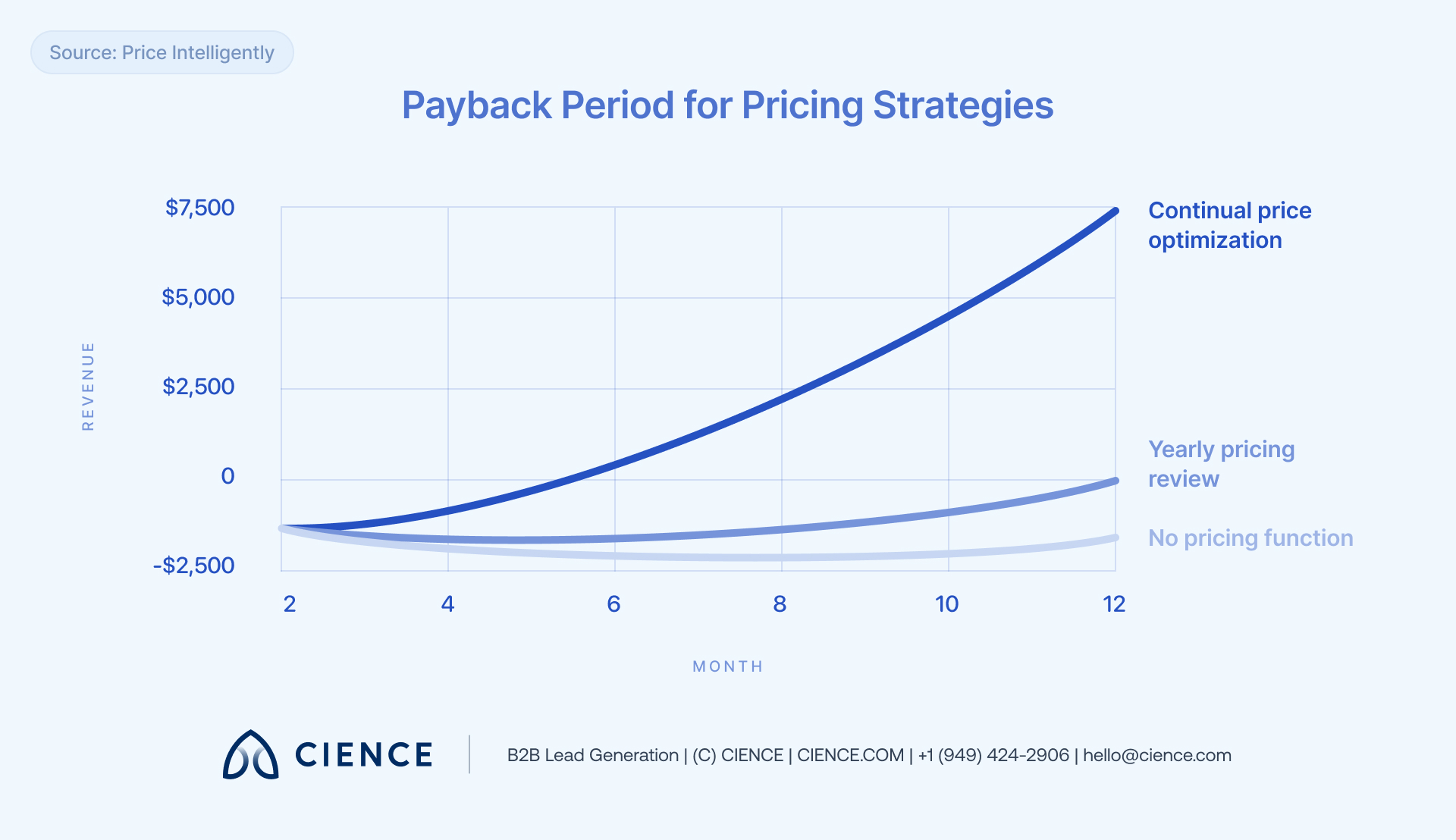
This data contrasts three pricing approaches and their relative payback over a twelve-month period. The blue line—no pricing function—is clearly the most costly for a company because it returns negative revenue. The red line—yearly pricing review—perhaps does not perform so well as might be expected, although it does eventually lead to positive company income after the first full year.
The most successful outcome, by far, is the golden line—continual price optimization. While such an approach may seem resource-intensive, the exponential growth in revenue far exceeds the returns of the other two approaches. Truly, it pays to be price-conscious throughout the year; pricing strategy cannot be a one-and-done consideration; it takes continual optimized pricing to achieve a solid foundation for growth.
4 Top B2B Pricing Models
To transform your B2B pricing strategy, you’ll first need to understand the fundamentals of pricing to achieve profitability and growth. Let’s take a look at these four main pricing models to help you redefine your business goals:
1. Cost-plus pricing
This is the most basic approach to product pricing due to its simplicity. Cost-plus pricing is a tried-and-tested way of figuring out product prices. Its focuses on not losing the company any money and aims to achieve profit in a straightforward way. At first glance, it appears to be a very sensible approach and is a solid bet for companies that are perhaps smaller, younger, generally risk-averse, or unwilling to operate at a loss for any given time period.
Cost-plus pricing asks the customer to pay the cost of overheads plus the profit margin per product. It is a very “fair” way of pricing because the connection between the company costs and the item value is very clear.
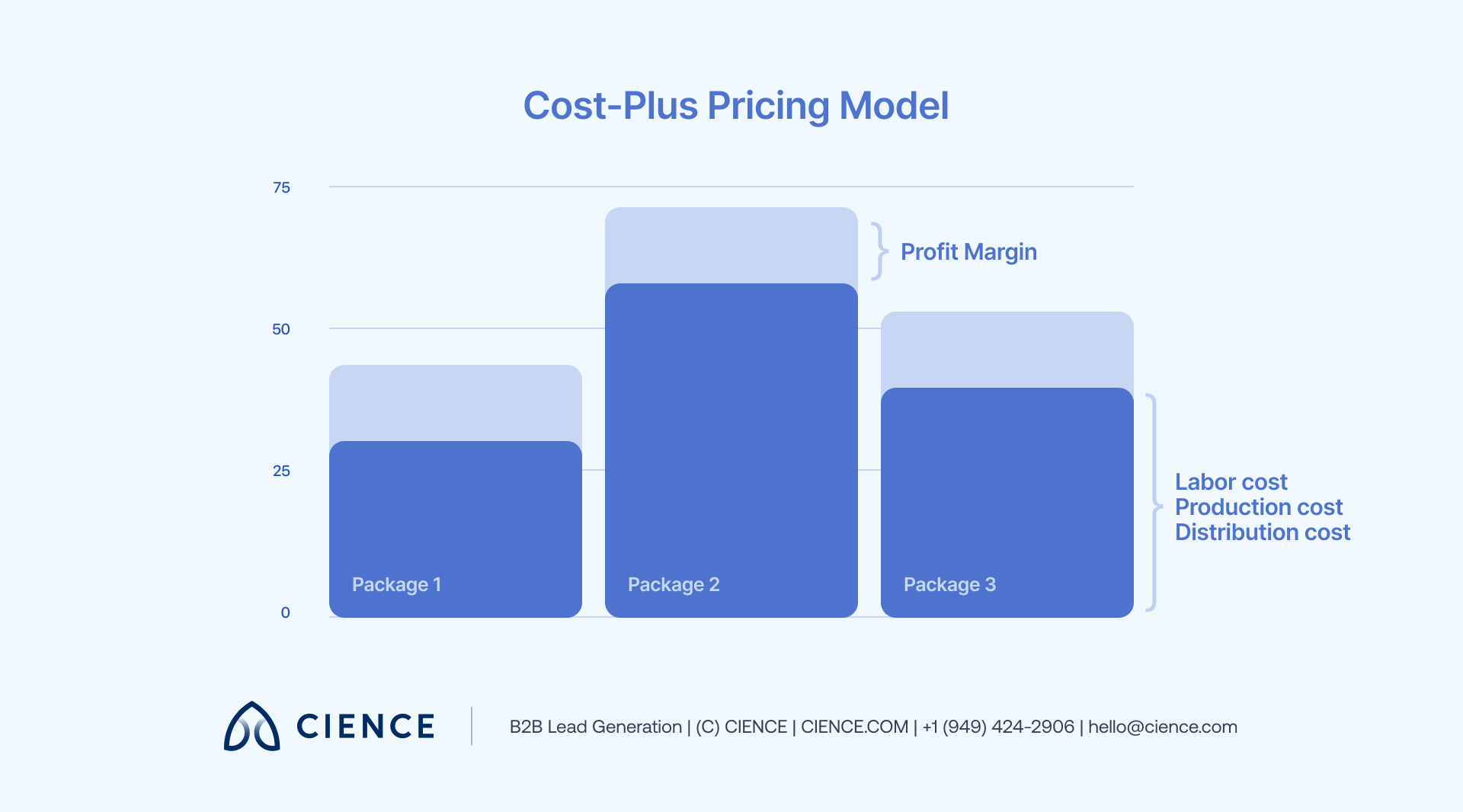
The above graph depicts products priced according to cost-plus pricing. The green section shows the 10% profit margin added on top of the base item price. The blue section is the total labor, production, and distribution costs.
Advantages of cost-plus pricing include:
- Easy to calculate
- Not resource-intensive
- Profits made on every item sale
Manufacturers of physical goods benefit most from cost-plus pricing owing to (generally) fixed or at least predictable production costs, for example, medical supplies, commodities, furniture, tools, and computers.
Drawbacks include the lack of insight into value creation for the customer. So books and educational resources, for instance, are harder to market using this strategy because their value to the end user is not equal to the sum of their manufacturing costs.
As far as marketing goes, a variety of approaches suit cost-plus pricing nicely. A technique known as “decoy pricing” can help here: Advertising a spotlight product at a certain price alongside a more expensive product makes the first one seem like a great deal.
2. Value-based pricing
This option compensates for intrinsic weaknesses of the cost-plus pricing model. Value-based pricing throws attention on the worth of the final product to the end user. Pricing is therefore much more closely linked to marketing because value creation lies therein.
Rather than looking at the cost of a product to your company, value-based pricing focuses solely on what the customer is willing to pay for the item or service. Of course, this means market research, customer feedback, and sales psychology take center stage.
Advantages of value-based pricing include:
- Greater opportunity for profit
- Fosters stronger connections with the customer base
- Gain more customer feedback
Many industries benefit from value-based pricing including software as a service (SaaS) providers, legal and financial services, and technology.
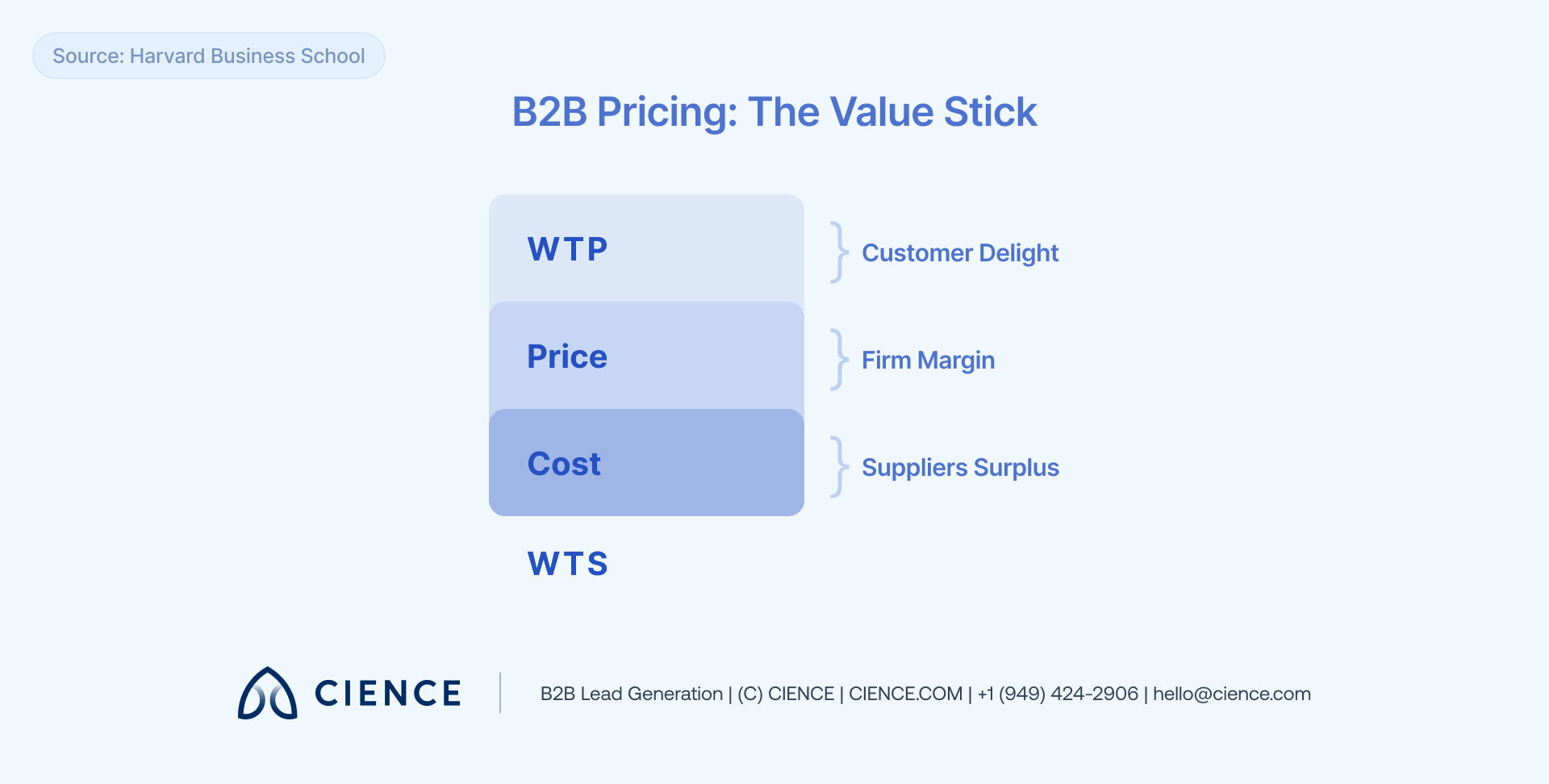
In the image above, “the value stick” refers to the components of value-based price. It closely resembles the cost-plus pricing model with the addition of willingness to pay (WTP). Also known as “customer delight,” the gap between the item’s raw cost and the highest price the customer is willing to pay is where the work of marketing takes place.
Much value creation takes place in the marketing department. Product teams need to trust the brand voice so marketing channels will hit the higher end of the WTP scale. A shift from quantity of marketing communications to quality is necessary for customer delight to take off. Therefore email marketing benchmarks and pay-per-click targets should focus less on overall numbers reached but on audience relevance and engagement.
3. Competition-based pricing
Realistically, your product or service is not terribly unique (sorry). Other highly capable actors in your industry are already providing similar offerings and customers enjoy a range of options to meet their needs.
Competitor-based pricing selects price points based on comparisons with alternative companies offering the same thing as you.
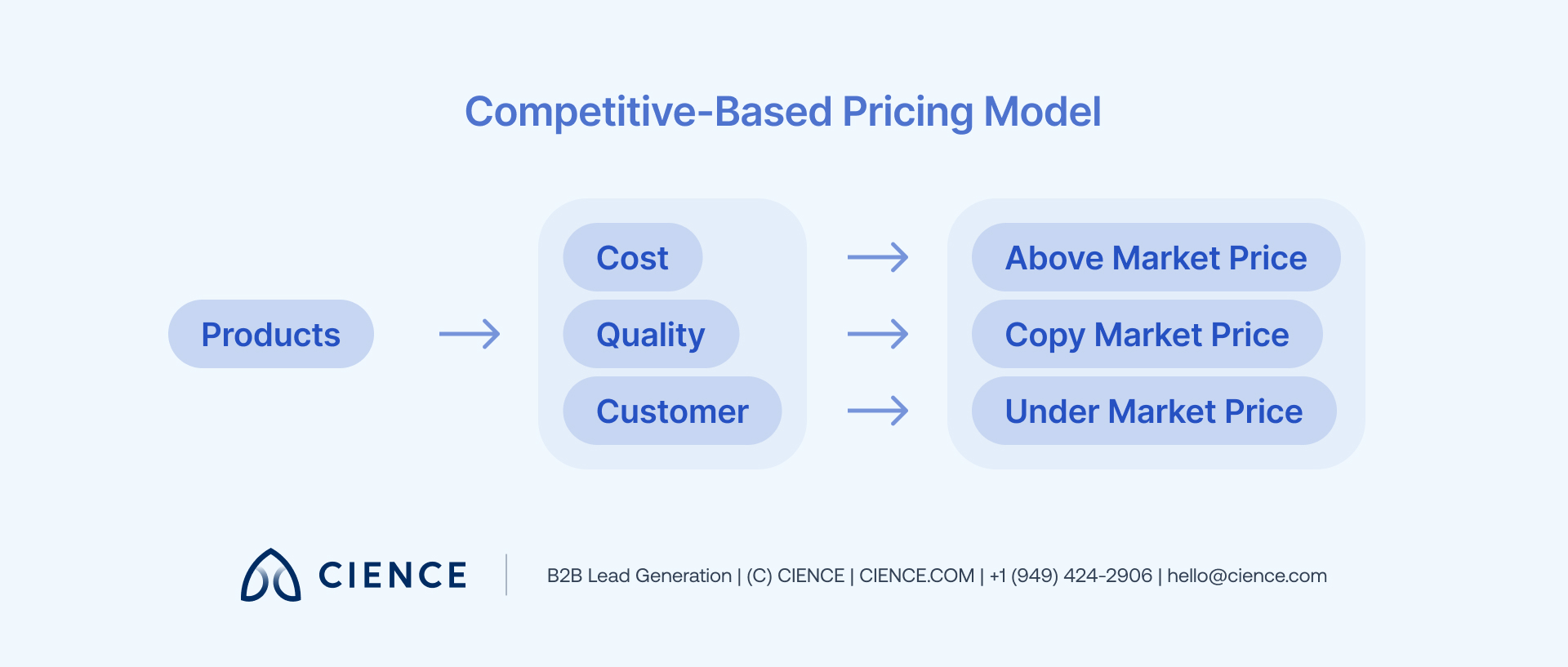
Web design companies may, for instance, search website personalization examples (as a prospective customer) to gather a range of quotes. Considering the additional features and benefits of each service offering, the business will set its rates within the range of data gathered.
For clients looking for a B2B website design to increase sales, several market options already crowd this space. Competitor-based price analysis therefore provides opportunities for product improvement, customer differentiation, and increased motivation for success.
Advantages of competitor-based pricing include:
- Noticeability and increased traffic
- More insight into competitors
- Usable with other pricing strategies
This strategy works well alongside a range of marketing strategies, particularly those that draw direct comparisons with competitors.
4. Dynamic pricing
This is the most complex and risky of pricing strategies yet may be the most profitable. Dynamic pricing involves constantly changing prices for your products in tandem with market fluctuations and customer demand. While this approach is resource-heavy, it may be suitable for certain specialized industries such as SaaS companies or technology manufacturers.
Although changing prices is not suitable for many, clients may not mind as much as you may think. Companies have increased their prices by as much as 60% and continued to sell at similar volumes. Pitching dynamic pricing to customers and sales reps takes some careful explaining.

Buyers in B2B corporations are experiencing an increasingly complex buying process with more stakeholders and decision-makers than a decade ago. Their time for research is limited as market options multiply, and “solution exploration,” i.e., gathering information on which products to buy, is short.
A recent Gartner survey found that 89% of buyers heard high-quality, relevant, and evidenced purchase information before reaching their decision. Buyers will most likely respond to higher or changing prices if given clear justification for it.
Today’s B2B customers expect sales representatives to help them make sense of the information overload that is the purchasing journey. If your reps can succinctly explain every facet of your product offering, from single-tenant cloud to a software test plan, buyers are far more likely to trust the pricing options on offer.
Advantages of dynamic pricing include:
- Greater adaptability to market forces
- Opportunities for large revenue gains
- Protecting your balance sheet
Drawbacks include the need for rich data analytics, which can be extremely hard to get hold of, not to mention expensive. Considerable time investment and sophisticated data tools are both needed.
That said, dynamic pricing is a tall order for a marketing team who will need continual updates about which prices are changing, how they are changing, and why. Such an approach would only work well with companies that maintain excellent communications with marketing and sales teams that deeply understand the product.
Build Solid B2B Pricing Strategies
Whether or not your company chooses a dynamic pricing strategy, good strong sales data should inform the way you sell at all times. With more news and information available than ever before, price disruptions are commonplace and companies cannot afford to be left behind with outdated methods.
If your outbound is producing diminishing returns despite more tools and more reps, the problem isn’t execution — it’s architecture.
The good news is marketing can adapt to almost any pricing strategy you choose. However, value-based pricing is where your marketing department has a great opportunity to shine. Higher prices can alienate B2B customers, but remember, volume is not everything, and when it comes to premium products a smaller pool of warmer clients is highly preferable.
“CIENCE helped us set up more than 190 qualified appointments, connecting us directly with the CEOs and founders we needed to reach. It gave us a scalable, predictable way to grow.” — Stage 1 Financial
CIENCE + graph8 pricing: $5,000 one-time GTM system setup, $2,499/mo strategic execution, and the graph8 platform at $499/mo. No long-term contracts. See full pricing →
Whether or not you decide to work with us, you’ll walk away with a clear picture of where your pipeline is leaking and what it would take to fix it.
“The conversion rate has been fantastic — about 10% of the 150 qualified companies they identified became real pipeline for us.” — Turn Technologies
CIENCE and graph8 have helped over 2,500 clients across 250+ industries build predictable pipeline — rated 4.6/5 on Capterra.
Frequently Asked Questions
What is the best pricing strategy for B2B companies?
Value-based pricing is generally the most effective strategy for B2B companies because it directly ties price to the perceived value a customer receives. This approach fosters stronger customer relationships and allows for greater profit margins. However, the best strategy depends on your industry, competition, and product type.
How often should B2B companies review their pricing?
Research shows that continual price optimization delivers exponential revenue growth compared to yearly reviews or no pricing function at all. At minimum, review pricing quarterly, but the most successful B2B companies monitor market signals and adjust pricing on an ongoing basis.
What is dynamic pricing in B2B?
Dynamic pricing involves constantly adjusting prices based on market fluctuations, demand, and competitive positioning. While resource-intensive, McKinsey data shows companies using dynamic pricing have increased prices by as much as 60% while maintaining similar sales volumes. It works best for SaaS companies and technology manufacturers with sophisticated data analytics capabilities.

A graph8 company — AI-powered GTM execution across 250+ B2B industries.
graph8 Platform
From $499/mo
Run your own GTM campaigns with AI-powered data, sequences, and analytics.
Start Free — 2,500 Credits No credit card requiredCIENCE Managed
From $2,499/mo
Our GTM teams build and run your outbound campaigns end-to-end.
15-min call · No commitment2,500+ B2B companies served · Month-to-month contracts · See full pricing →