
Track these 7 inbound marketing KPIs to grow your business: website traffic, lead quality (MQLs and SQLs), conversion rate, customer lifetime value, social media engagement, mobile performance, and SEO ROI. Data-driven businesses are 58% more likely to hit revenue goals — and CIENCE has helped 2,500+ clients across 250+ industries build measurement-driven pipelines.
Last Refreshed: March 2026 with updated statistics and tool information.
Inbound marketing KPIs are the measurable metrics — such as website traffic, conversion rate, lead quality, and SEO ROI — that tell you whether your content-driven marketing efforts are actually generating revenue. Companies are always looking for new ways of getting more people to spend more money on their products and services. And one of the best ways of doing that is through marketing — inbound marketing in particular.
From Thomas Cornelius, Founder & CEO, graph8: “Most companies track vanity metrics — page views, social likes — and wonder why their pipeline doesn’t grow. The KPIs that actually matter are the ones that map directly to revenue: lead quality, conversion rate at each funnel stage, and SEO return on investment.”
However, saying it is the best does not mean it is simple. There is an almost infinite number of things you can track, evaluate, and tweak in inbound marketing. In this article, we will look at a few of them. More specifically, we will discuss the seven most important inbound marketing key performance indicators (KPIs) you can use to grow your business.
What Is Inbound Marketing?
Inbound marketing is a strategic approach to attracting customers via valuable content and tailored experiences. Its goal is to inspire organic, long-term customer relationships and raise a company’s authority within its niche. Examples of inbound marketing include:
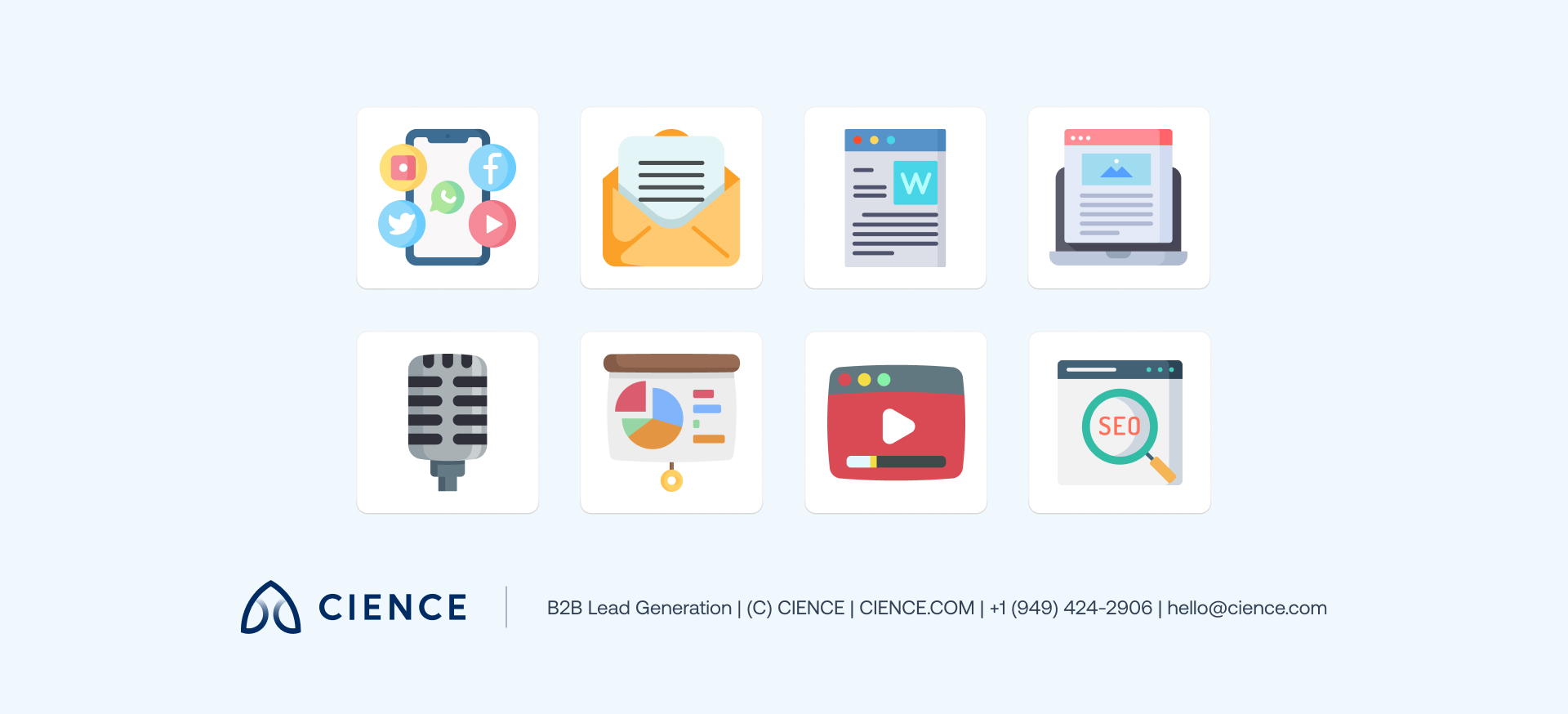
- Social media posts: Creating social media content is a highly effective way to expand your brand visibility, drive engagement, and grow your audience.
- Email campaigns. Email marketing allows you to build one-on-one relationships with your customers and potential buyers.
- Infographics: These visual images allow you to present a significant amount of information quickly and concisely to attract your target audience.
- Blog posts: Writing blog posts helps you share valuable information, show expertise in your field, and engage readers about your brand.
- Podcasts: Weekly podcasts offer expert insights on specific topics to reach the intended audience or niche market.
- Webinars: This marketing tool helps potential customers better understand your products and services by offering expert guidance and B2B data solutions.
- Videos: Producing short, dynamic videos can help build brand awareness, drive followers to other channels, and convert prospects into customers.
- SEO: Search engine optimization is an essential way to attract relevant searchers to your content and increase organic traffic.
In contrast to outbound marketing, customers proactively search and engage with your company through relevant content and channels that address their interests and needs.
Inbound or Outbound: What to Choose?
How to Choose Relevant Inbound Marketing KPIs
Measuring KPIs is a vital aspect of any company’s activities. They allow you to create insightful reports on your business, evaluate your performance more efficiently, and make informed decisions regarding your strategies. The types of KPIs most often associated with inbound marketing are:
- Inputs: These measure how many resources you invest in producing the desired result such as money and work hours.
- Processes: These assess the efficiency of the techniques used such as the time it took to complete a marketing campaign.
- Outputs: These reflect how much work was done like pieces of content produced.
- Outcomes: This details the results stemming from outputs, including brand awareness, website traffic, and conversion rate.
- Project: This part focuses on the project itself (e.g., schedules, risks, etc.)
The key to creating an effective marketing KPI strategy is to choose the metrics that align with your company’s needs and wants. Market standards also dictate that your KPIs should be straightforward, actionable, and relevant. Here’s what that means in practice:
- Straightforward: This means simple to track and easy to measure. Your employees must understand what they are working toward and how to know if they have met the requirements.
- Actionable: The best KPIs should provide helpful insights you can quickly incorporate into your processes. If you cannot make turn-key decisions based on the results you observe, you may need to rethink your strategy.
- Relevant: Perhaps an obvious recommendation, but your KPIs should reflect your current marketing goals. For example, if brand awareness is your current goal, you should track KPIs such as engagement and reach.
The 7 KPIs You Should Track for Inbound Marketing
The KPIs you choose for your inbound marketing campaign are ultimately up to you. However, there are some best practices to consider. If you want to get the most out of your marketing efforts — raising your return on investment (ROI) and attracting as many customers as possible — you should measure the following KPIs:
1. Website traffic
Website traffic is the metric that indicates how many people visit your website. You can even use it to track visitors for a single page, during a certain timeframe, coming from a specific site or using a particular device or browser.
However, overall website traffic can be an excellent indicator of your performance. If you publish a new article and your visitor count skyrockets, it was probably a good one. On the other hand, if traffic drops following a change to your site, you may want to rethink your approach.
We also recommend tracking bounce rate, average time on site, and unique visitors in your analytics, as they can be an invaluable resource.
2. Quality of leads
As the name would suggest, this metric tracks the amount of quality leads you acquire within a given time frame. Nowadays, most businesses prioritize the quality of leads over quantity, as it typically leads to higher profits in the long run. Quality leads can be divided into two types:
- MQL (marketing qualified lead): MQLs are customers who are currently looking for a solution to whatever problem they are facing. In their search, they come across your content and show interest. From that point on, it is the job of your marketing team to target these people and get them to start considering a purchase.
- SQL (sales qualified lead): SQLs are customers previously convinced by the marketing team to consider a purchase. At this point, your sales team begins communicating with them in an attempt to close the deal.
The number of leads you qualify correlates directly to your marketing and sales teams’ performance. If you struggle with acquiring MQLs, it may be a sign you should rethink your marketing strategies. On the other hand, if you manage to convert MQLs into SQLs but see a sharp drop in the number of leads who become actual customers, you might need to look at your sales team.
3. Conversion rate
Simply put, the conversion rate metric is the percentage of people who complete a desired action. This can include downloading an e-book, signing up for a newsletter, watching a product demo, or anything else that has value for your business.
To make full use of it, you first need to establish which actions are most meaningful to customers. Once you know that, you can begin tracking those specific conversions and use them to optimize your future marketing efforts.
4. Customer lifetime value (CLV)
A customer’s lifetime value is an invaluable metric. It is the total value a customer brought to you over the entirety of their relationship with your business. It is usually much easier to retain and profit off repeat clients rather than try to convert new ones. Therefore it’s in your best interest to keep your current clientele happy and satisfied.
5. Reach and engagement of social media posts
Social media has become a significant driving force behind marketing and business in the current digital age. It allows users to interact with their favorite brands on an unprecedented level, and you would do well to take advantage of that. The two most important metrics you should pay attention to are:
- Reach: How many people saw your post.
- Engagement: How many people interacted (liked, commented, or shared) with your post.
These two metrics are important as they help you better understand what your audience wants to see. Most social media platforms even include their analytics to help you keep track of these.
6. Traffic, leads, and conversion rates from mobile
According to Statista research, mobile devices now generate over 60% of global website traffic — a share that has grown steadily every year. Suffice it to say that many people view content almost exclusively on their phones and tablets. For a better user experience, ensure your website is cross-browser tested and optimized.
That’s why these three metrics are vital if you want to succeed in today’s online market. You should design your inbound marketing strategy to reflect the way people interact with your content so that you can better cater to their needs.
If there is a significant difference between your desktop and mobile traffic, leads, and conversions, consider whether it’s due to your audience’s specific tastes or your content being poorly optimized for mobile.

7. SEO return on investment
Costs of financing in SEO will vary significantly, depending on whether you decide to hire a freelancer for content writing and link building, hire an agency, an in-house SEO team, or take a do-it-yourself approach. Within that, prices will vary significantly from one agency to the next.
“The team at CIENCE has quadrupled our organic traffic in a fraction of the time, cost, and total resources it would have taken our internal team to accomplish the same tasks.” — Wesley Knowles, Co-Founder, Hirebook
When your cost per lead keeps climbing but pipeline stays flat, adding another tool won’t fix it. You need a different system.
ROI is the holy grail of KPIs. It’s crucial in evaluating your marketing budget. If your ROI percentage is low or negative, it’s a clear indicator that something is wrong. Keep track of this number, compare your previous quarterly and annual reports, and learn from the past.
Boost Your Inbound Marketing Strategies
Throughout this article, we laid bare some of inbound marketing’s most crucial KPIs. Now, armed with this knowledge, you can boost the efficiency of your analytics. Use the insights to inform your marketing decisions, and watch as your business grows before your eyes. CIENCE has worked with 2,500+ clients across 250+ industries — rated 4.6/5 on Capterra — to build measurement-driven pipelines that convert content into revenue. Explore our inbound SDR services →
Learn How to Strengthen Your Inbound Marketing
“Thanks to CIENCE, we’ve seen a 500% monthly increase in new sales appointments.” — Bryce Garoutte, Sr. VP of Business Dev & Marketing, Silicon Valley Insight
CIENCE + graph8 pricing: $5,000 one-time GTM system setup, $2,499/mo strategic execution, and the graph8 platform at $499/mo. No long-term contracts. See full pricing →
Whether or not you decide to work with us, you’ll walk away with a clear picture of where your pipeline is leaking and what it would take to fix it.
Frequently Asked Questions
What are the most important inbound marketing KPIs to track?
The 7 most important inbound marketing KPIs are website traffic, lead quality (MQLs and SQLs), conversion rate, customer lifetime value (CLV), social media reach and engagement, mobile traffic and conversions, and SEO return on investment. These metrics give you a complete picture of how your content attracts, engages, and converts visitors into customers.
How often should I review my inbound marketing KPIs?
Review your inbound marketing KPIs at least monthly, with weekly check-ins on high-velocity metrics like website traffic and conversion rates. Quarterly reviews are best for longer-cycle metrics like customer lifetime value and SEO ROI, where trends become meaningful only over a 90-day window.
What is the difference between MQLs and SQLs?
Marketing qualified leads (MQLs) are prospects who have shown interest in your content and are being nurtured by your marketing team. Sales qualified leads (SQLs) are MQLs that the marketing team has vetted and handed off to sales for direct outreach. The conversion rate between MQLs and SQLs is a critical indicator of marketing-sales alignment.

A graph8 company — AI-powered GTM execution across 250+ B2B industries.
graph8 Platform
From $499/mo
Run your own GTM campaigns with AI-powered data, sequences, and analytics.
Start Free — 2,500 Credits No credit card requiredCIENCE Managed
From $2,499/mo
Our GTM teams build and run your outbound campaigns end-to-end.
15-min call · No commitment2,500+ B2B companies served · Month-to-month contracts · See full pricing →