
Data quality in B2B sales refers to how accurate, complete, consistent, timely, and unique your dataset is. Only 13% of data-driven companies consider their data good enough to be a strategic asset — and poor data wastes 21% of marketing budgets. The 5 ways to fix it: set ICP-based quality standards, centralize data in one system, enrich your CRM with clean records, build a data-friendly culture, and outsource to a provider like CIENCE (serving 2,500+ clients across 250+ industries) for 95%+ accuracy.
Last Refreshed: March 2026 with updated statistics and tool information.
Data quality in B2B sales refers to the accuracy, completeness, consistency, timeliness, and uniqueness of the customer and prospect data your teams use for outreach, targeting, and decision-making. Poor data quality wastes 21% of marketing budgets on inefficient decisions, while only 13% of companies rate their data as strategically useful.
From Daniel Conn, GTM Strategist, graph8: “Most teams think they have a volume problem when they actually have a data quality problem. A list of 5,000 contacts at 60% accuracy will underperform a list of 500 at 95% accuracy every time — and cost you twice as much in SDR hours to find out.”
A recent push toward digital marketing has imposed a growing urge for data-backed solutions in B2B sales. Since the beginning of the COVID-19 pandemic, 84% of business leaders have noticed a greater demand for data insights throughout different departments of their organizations. Nearly half of them (49%) assert that data analytics is the key factor behind better decision-making capabilities.
At the same time, maintaining good data quality turns out to be a real challenge. Only 13% of companies that have already adopted a data approach stated that their dataset is good enough to view it as a strategic asset. The majority of businesses have poor data with little unique input, or their data has limited usage, which makes the substantial analysis more challenging.
To embrace the full power of the data-based approach in B2B, companies need to boost sales data quality. To achieve this, it is essential to first identify what data quality means and what impact it has on your business.
What Is Data Quality?
Data quality refers to the condition your dataset is in at the moment and how well it serves its function. As it is usually hard to evaluate the quality of the data collected, there are some general criteria every dataset needs to meet:
- Accuracy: How well does your dataset represent reality?
- Completeness: How complete is the information you gather?
- Consistency: How precise is your input compared to other sources of information?
- Timeliness: Is your data up-to-date?
- Validity: How does your dataset represent what you intended to measure?
- Uniqueness: How exclusive is the information you gather?
As a rule of thumb, high-quality sales data fits all these criteria and is well-integrated inside the entire organization, not just the IT, sales, or marketing team.
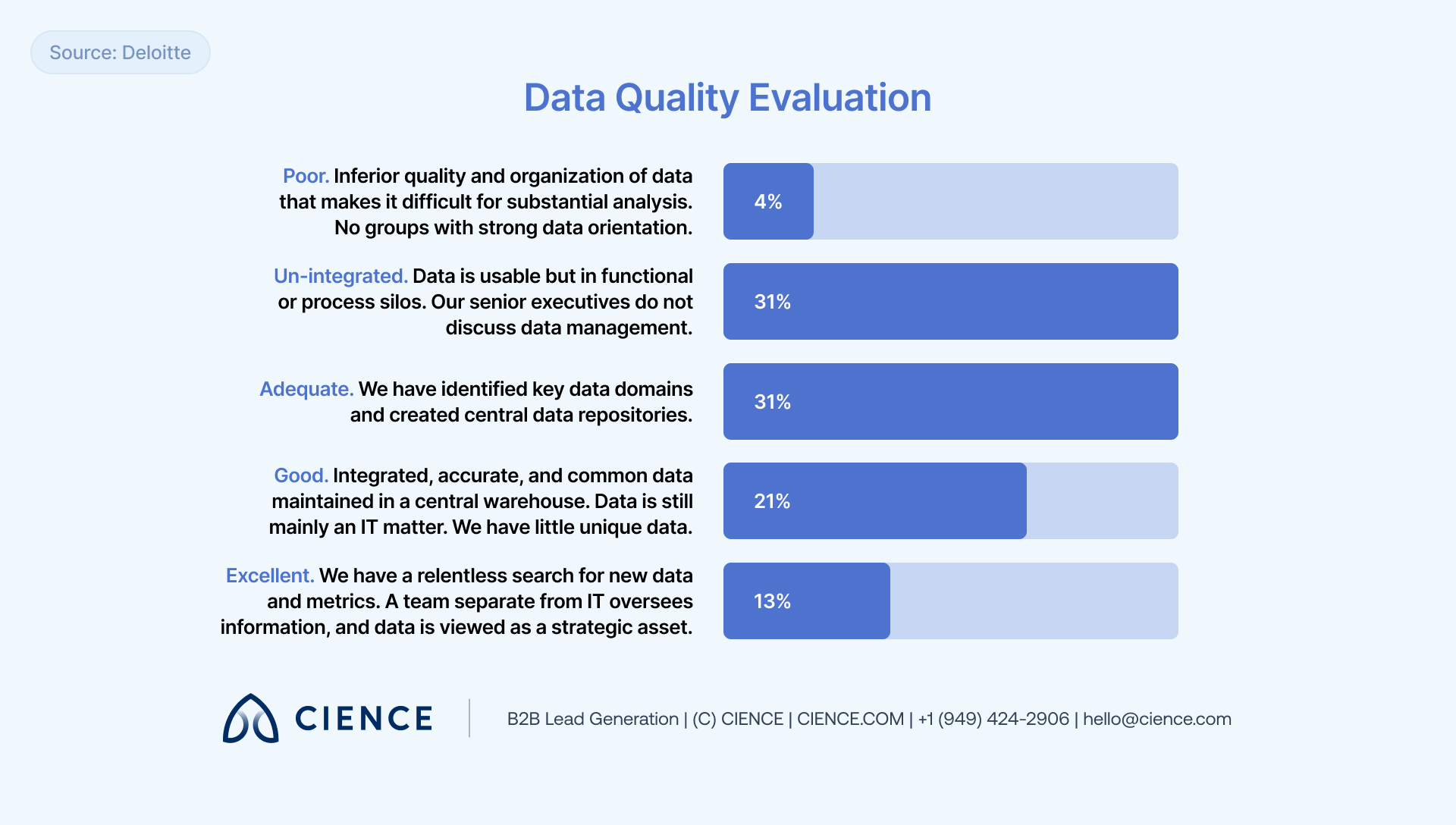
Source: Deloitte
Impact of Poor Data Quality
Bad data can significantly harm both sales and marketing teams, customers, and businesses in general. Here are some of the most crucial consequences of using poor data:
1. Dirty data harms the efficiency of the sales team.
Sales development representatives (SDRs) waste hours of their work time dealing with dirty data. Misspelled names, outdated email addresses, and wrong phone numbers lead to lost sales opportunities and decreased conversions. This in turn negatively affects SDRs’ motivation to work. Dealing with refusal, overcoming call reluctance syndrome, and handling sales objections are hard enough. Complicating salespeople’s jobs with bad data can become the tipping point for your sales team.
2. Bad data worsens the customers’ experience with you.
There is a general rule that acquiring a new customer is five times more expensive than retaining an existing one. At the same time, loyal clients are the ones who lead your business to grow, as they are more likely to buy or recommend your services to others.
That is why high-quality data collection is essential for sales. Simple mistakes like spelling somebody’s name incorrectly or mixing up their job title, or sending duplicate messages create a wrong impression about your business and might lead to losing loyal clientele.
3. Poor data leads to wasting marketing budgets.
Data quality and B2B marketing effectiveness are also codependent on each other. Marketing Evolution research shows that incomplete or inaccurate data is responsible for spending 21% of the marketing budget on inefficient decisions. Incorrect targeting, poor personalization, and irrelevant content can seriously damage the results of your marketing campaign. That is why the actual cost of bad data is higher than just lost sales opportunities.
5 Tips to Boost Data Quality in Sales
There are multiple direct and indirect consequences of using poor data quality in B2B sales. Luckily, there are ways to improve it significantly through establishing proper data collection and data management processes.
1. Set up data quality standards and follow them.
Each business is unique. What works for your competitors might drive zero success for you. What sells well in other industries can be totally irrelevant to your clients. This is precisely the reason why before starting any new initiative, you need to do in-depth research on your target audience so you understand their needs and values better.
Therefore, the first thing to do to improve data quality is to identify as many data points as possible about your ideal customer profile (ICP). The information you should gather varies from one business to another. This can include their age, industry, company size, area of living, and more.
After you know your ICP well enough, it will be easier to determine the data quality metrics that affect the sale in your industry the most. You are free to define any data quality objectives you think are relevant to your business, and then create your own system of data quality evaluation. The only thing to remember: Data quality management is an ongoing project, and it will take a while until you see the first results.
2. Organize all existing data in one place.
Another challenge that significantly affects data quality is the absence of a unified and standardized single source of data. It is a common situation when sales use one software, the marketing team another one, and the IT department the third one. This in turn desynchronizes the teams, leads to miscommunication, and thus, the upsurge of dirty data.
Instead, align your forces all together in one place to see the entire picture from different perspectives. A recent report by Forrester and LinkedIn stated that 87% of respondents think that collaboration between sales and marketing teams facilitates critical business growth, and 98% of them said that bad alignment negatively impacts both the business and the customer.
By developing a central system for all data operations, you enable your teams to collaborate with each other more often, exchange insights, and thus build stronger ties between departments to improve business processes and customer experience with you.
3. Enrich your CRM system with high-quality data.
According to Experian research, when it comes to data governance, establishing consistency around the organization is the primary challenge for 42% of respondents. The best way to overcome this challenge is to set up a single customer relationship management (CRM) system throughout the entire organization. However, the efficiency of your CRM depends purely on the data quality collected.
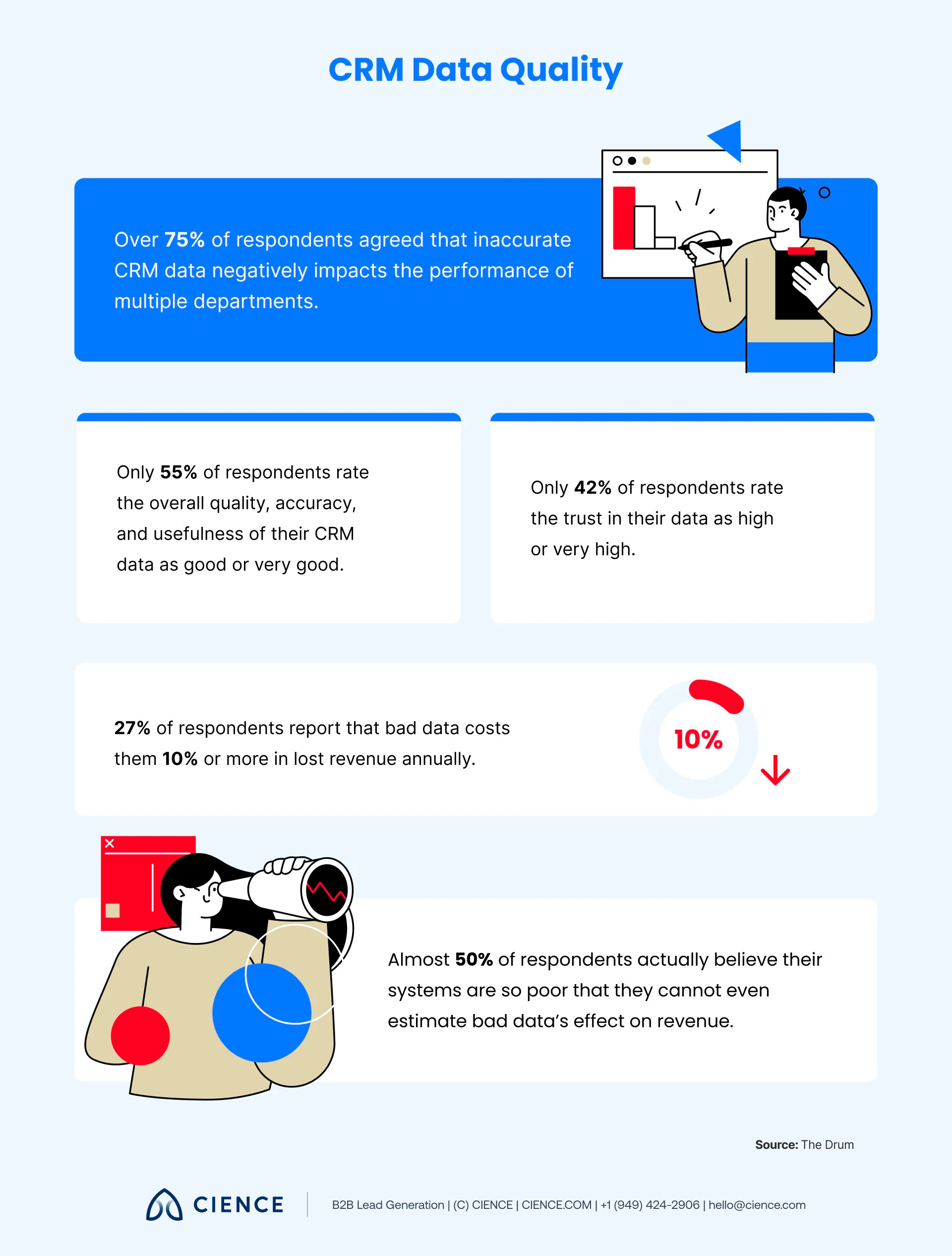
Enhancing your CRM with clean data allows your team to access information more easily, target prospects more precisely, and shorten the sales cycle significantly. Simple things like inserting a country code in a proper way, double-checking clients’ name spelling, or updating their job title can make a huge difference during the data collection process.
At the same time, avoid overloading your teams with CRM customizations. Instead, focus on developing dynamic data management to allow your salespeople to focus on more essential tasks than just data collection.
Check out data enrichment strategies for B2B teams.
4. Form a data-friendly culture in your organization.
Establishing a data-driven culture comes with certain benefits and challenges. On the one hand, it helps to build better relationships with customers (61%), extract better insights for decision making (59%), and adapt more efficient business practices (57%).
On the other hand, it is not that easy to convince your team members to change their workflow in favor of data-driven strategies. To initiate this transition, make sure to explain to your executives that high-quality data isn’t just a trend but a necessity that will simplify your team’s jobs and even make their effort more profitable.
Besides that, to lay the foundation of data culture, you need to also train your team to work with the received input, set up policies to evaluate data quality regularly, and assign data management to an internal team. Without that, it will be impossible to maintain decent data quality for B2B sales purposes.

5. Consider outsourcing data solutions.
There are multiple reasons to set up a first-party data strategy in sales. It helps you to understand your customer better, build stronger connections with your audience, and enhance your marketing efforts. At the same time, first-party data requires significant investments for its maintenance and collection.
The sad truth is that no matter how good your data is at the moment, with time it will start to decay. People move to other cities, prospects change their jobs, businesses expand to new markets—all of this makes your dataset outdated with every minute.
“We worked with the CIENCE team to identify better ways to build lead lists and relax lead constraints. A little bit of lead iteration and finding new approaches to find viable companies helped us to get those 8-10 sign ups per week.” — Federico Menapace, Head of Technology Partnerships, Segment
Bad data doesn’t just waste budget — it trains your team to accept poor results as normal. Clean intelligence changes everything.
Because of that, more and more companies prefer to rely on second- and third-party data to build their strategies. In case your organization doesn’t have enough resources to sustain data nurturing on a permanent basis, you can always search for solutions from third parties. CIENCE — a graph8 company serving 2,500+ clients across 250+ industries — offers customized, AI-driven, up-to-date datasets to help you build better lead generation and sales strategies with 95%+ contact accuracy.
Make Quality Data Your Strongest Asset
Data solutions are the key to succeeding in B2B sales. They can notably boost your conversions and lead you to the next level in the business game. Or they can drag you back to the start if your data quality isn’t good enough.
Maintaining a high-quality dataset is essential when making key business decisions based on it. Evaluate your resources and think about which strategy will be more beneficial for your organization: building a first-party dataset or outsourcing it to a trusted source? Whatever choice you make, always remember that good data quality is the present and the future of business.
“Increased monthly appointments over 500%.” — Silicon Valley Insight (IT Services)
CIENCE + graph8 pricing: $5,000 one-time GTM system setup, $2,499/mo strategic execution, and the graph8 platform at $499/mo. No long-term contracts. See full pricing →
Whether or not you decide to work with us, you’ll walk away with a clear picture of where your pipeline is leaking and what it would take to fix it.
Frequently Asked Questions
What is data quality in B2B sales?
Data quality in B2B sales refers to how accurate, complete, consistent, timely, valid, and unique your prospect and customer data is. High-quality data enables SDRs to reach the right contacts with correct information, reduces wasted outreach, and directly improves conversion rates. Only 13% of companies that use data-driven approaches rate their data as good enough to be a strategic asset.
How much does bad data cost a business?
Poor data quality costs businesses an estimated 21% of their marketing budget through inefficient targeting, poor personalization, and irrelevant content. SDRs also waste significant work hours dealing with misspelled names, outdated email addresses, and wrong phone numbers, leading to lost sales opportunities and decreased team morale.
Should I build first-party data or outsource data solutions?
The best approach depends on your resources and goals. First-party data is the most accurate and privacy-compliant, but it requires significant investment in collection infrastructure and ongoing maintenance as data decays over time. Outsourcing to providers like CIENCE gives you access to AI-driven, regularly updated datasets with 95%+ accuracy — rated 4.6/5 on Capterra — making it ideal for companies that lack internal data teams.

A graph8 company — AI-powered GTM execution across 250+ B2B industries.
graph8 Platform
From $499/mo
Run your own GTM campaigns with AI-powered data, sequences, and analytics.
Start Free — 2,500 Credits No credit card requiredCIENCE Managed
From $2,499/mo
Our GTM teams build and run your outbound campaigns end-to-end.
15-min call · No commitment2,500+ B2B companies served · Month-to-month contracts · See full pricing →