
Three MarTech trends are reshaping B2B in 2026: marketers use only 1/3 of their stack's capability, MarTech vendors are consolidating after peaking in 2023, and the global market is projected to grow from $329B to $1.7T by 2032 (18.5% CAGR). AI agents are replacing fragmented SaaS dashboards.
The MarTech landscape is being reshaped by 3 converging forces: most marketers use only one-third of their stack’s capability, vendor consolidation is accelerating, and AI agents are replacing traditional SaaS dashboards entirely.
From Thomas Cornelius, Founder & CEO, graph8 (formerly Founder, CIENCE): “Most companies aren’t losing to competitors with better products — they’re losing to competitors with better GTM architecture. The MarTech stack you build in 2026 will determine whether your pipeline scales or stalls.”
The MarTech landscape moves fast — but three specific signals stand out. Three separate surveys and studies caught our attention:


From Martech.org, “Marketers are only using 1/3 of their stack’s capability” — revealing that most teams are only tapping into a third of their tech stack’s true potential.

Chiefmartec.com chimed in with insights on the slowing cycle of MarTech replacement — how MarTech stacks are finally finding some stability after years of runaway expansion.

A report from Allied Market Research indicating the global marketing technology market was valued at $329 billion in 2022, and is projected to reach $1.7 trillion by 2032.
While these trends highlight the challenges B2B teams face, they also illuminate the path forward. Here are insights and strategies to navigate the MarTech maze with confidence — and come out ahead.

Tapping into the Full Potential of MarTech
Most teams invest significant resources — time and money — into these tools expecting to revolutionize their marketing. Yet somewhere along the line, they’re leaving a massive amount of value untouched. It’s like having a Ferrari and never taking it out of first gear.
Is it the overwhelming pace of feature releases? A gap in training and resources? Poor integration between disparate tools? In most cases, it’s all three.
The opportunity is clear: consolidate, train, and go deep on fewer platforms rather than accumulating more surface-level tools. Marketers who master their existing stack will outperform those chasing the next shiny product.
These are some of the main reasons we built CIENCE into a software-first company — combining nine disparate components into a single, cohesive lead generation platform.
The “Stabilizing” MarTech Landscape
In the ever-evolving world of MarTech, external factors often play a pivotal role in shaping trends. The recent slowdown in MarTech replacement, as highlighted by Chiefmartec.com, isn’t a conscious move toward stability. It’s a reflection of economic pressure.
The tech recession forced many teams to tighten their belts, reducing spend on new platforms. This financial squeeze, while challenging, emphasized the importance of maximizing the potential of existing tools. Innovation isn’t just a buzzword in this environment — it’s a survival skill. Marketers are now tasked with being resourceful, finding new ways to leverage their current tech stacks to drive measurable results.
CIENCE works with 2,500+ clients across 250+ industries, and the pattern is consistent: the teams winning in a tight budget environment aren’t the ones with the most tools — they’re the ones getting the most out of fewer, better-integrated platforms.

A Deeper Dive into MarTech’s Future
The projections from Allied Market Research are hard to ignore. We’re looking at a leap from $329 billion in 2022 to $1.7 trillion by 2032 — a compound annual growth rate of 18.5%.
Two drivers behind this growth:
- AI Advantage: Marketing departments worldwide are racing to embrace Generative AI technology. The offerings from Gen AI companies are purpose-built for marketers, promising immediate and measurable impact at scale.
- Tribute to Tech: That $1.7T projection is a testament to MarTech’s growing significance in global commerce. As digital transformation sweeps across sectors, demand for execution-layer marketing technology will only intensify.
With this growth comes responsibility. Every dollar invested in MarTech needs to produce measurable ROI. Use the ROI calculator to benchmark what your current stack should be delivering — and where the gap is.

In these rapidly evolving times, staying ahead of the curve requires understanding which trends are structural shifts — not temporary noise. The three trends above are structural.
Still scaling headcount to scale pipeline? There’s a faster, more predictable way to build revenue.
“CIENCE Technologies delivered a fantastic quality of work and a second-to-none work ethic — exactly what we needed to build a scalable pipeline.” — Instapage (SaaS)
2026 Update: What’s Changed Since We First Published This
Last Refreshed: March 2026 — updated AI agents section, expanded MarTech consolidation data, added 2026 pricing context and graph8 platform overview.
The three trends we flagged above have only accelerated. Here’s what’s shifted since:
AI Agents Are Now the Stack
In 2023, we were talking about AI as a feature inside tools. By 2026, AI agents are the tools. The MarTech stack is no longer a collection of SaaS apps with dashboards — it’s a set of AI-native workflows that execute autonomously across data, outreach, and analytics. Companies that haven’t made this shift are paying for software they’re using as expensive spreadsheets.
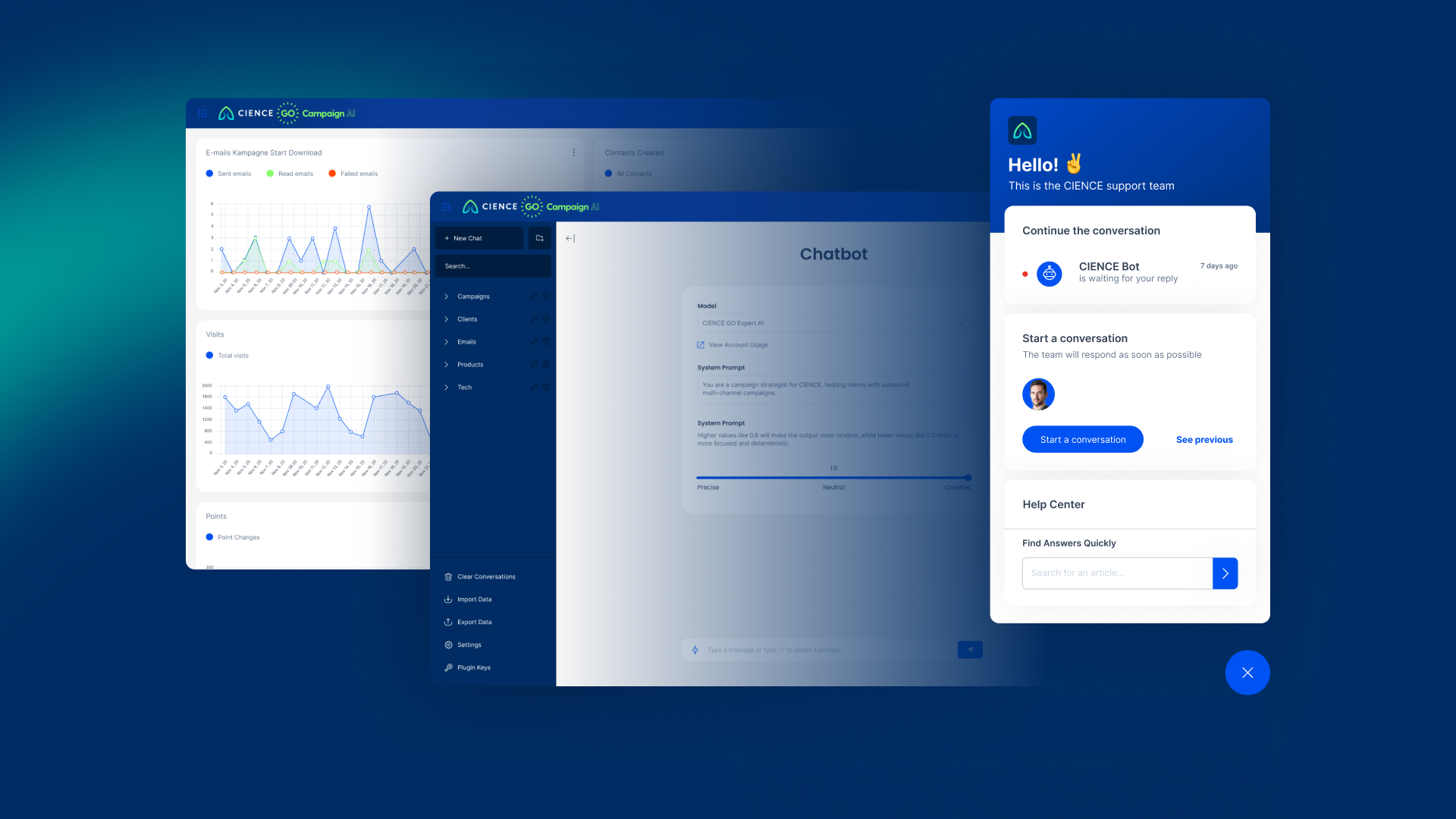
At CIENCE, this is exactly why being a graph8 company matters. The entire platform was built on graph8 AI infrastructure — not bolted onto existing workflows. GO Campaign AI generates multi-channel outreach sequences. GO Intent continuously monitors 34M+ web pages for buyer signals. GO Digital executes programmatic B2B advertising with 100+ targeting filters. It’s an orchestrated AI execution layer, not a dashboard.
MarTech Consolidation Accelerated Further
The “stabilizing” trend we noted in 2023 became a full contraction by 2025. The number of MarTech vendors peaked around 2023 and has been consolidating since — acquisitions, shutdowns, and platform roll-ups. For buyers, this means the fragmented 50-tool stack is no longer viable. Teams are moving toward 3-5 platforms that deeply integrate.
CIENCE GO was built for exactly this consolidation moment. GO Data, GO Intent, GO Show, GO Digital, GO Engage — one platform, one data model, one view of your entire GTM motion. Learn more about outbound SDR services and how the platform powers them.
The $1.7 Trillion Forecast Is Still Tracking
Allied Market Research’s projection to $1.7 trillion by 2032 looks plausible. The driver isn’t more tools — it’s AI execution capacity replacing human labor at scale. Every SDR team, every campaign operation, every RevOps function is being repriced as AI proves it can handle 70–80% of the volume work. The remaining 20–30% — judgment, relationships, strategy — is where human + AI teams like CIENCE’s model win.
Still scaling headcount to scale pipeline? There’s a faster, more predictable way to build revenue.
“CIENCE Technologies secured about 30 meetings with ideal prospects, several of which represented Fortune 500 companies.” — Ben Kraus, Head of Sales, Jane.ai
CIENCE + graph8 pricing: $5,000 one-time GTM system setup, $2,499/mo strategic execution, and the graph8 platform at $499/mo. No long-term contracts. See full pricing →
Whether or not you decide to work with us, you’ll walk away with a clear picture of where your pipeline is leaking and what it would take to fix it.
“Wrike found CIENCE to be true professionals with reliable delivery — exactly what a scaling team needs from an outbound partner.” — Wrike (Project Management SaaS)
Frequently Asked Questions
Why are marketers only using one-third of their MarTech stack?
The gap comes from three factors: overwhelming pace of feature releases, insufficient team training, and poor integration between tools. Most companies buy MarTech faster than they can adopt it, resulting in expensive software used as glorified spreadsheets. The fix is consolidating to fewer, deeply integrated platforms rather than adding more point solutions.
Is MarTech consolidation good for buyers?
Yes. The number of MarTech vendors peaked around 2023 and has been contracting through acquisitions and shutdowns since. For buyers, this means less vendor fragmentation and better integration between tools. Teams are moving from 50-tool stacks to 3–5 deeply integrated platforms. This consolidation reduces total cost, simplifies operations, and improves data quality.
How big will the MarTech market be by 2032?
Allied Market Research projects the global MarTech market will grow from $329 billion in 2022 to $1.7 trillion by 2032 — an 18.5% compound annual growth rate. The growth driver is not more tools but AI execution capacity replacing human labor at scale across SDR teams, campaign operations, and RevOps functions.
What is the question for B2B companies adopting AI-native MarTech?
The question for your business isn’t whether to adopt AI-native MarTech. It’s whether you’re adopting the right architecture before your competitors do. Companies that consolidate to an orchestrated AI execution layer — combining data, outreach, intent, and analytics — will have a structural pipeline advantage through 2032.

A graph8 company — AI-powered GTM execution across 250+ B2B industries.
graph8 Platform
From $499/mo
Run your own GTM campaigns with AI-powered data, sequences, and analytics.
Start Free — 2,500 Credits No credit card requiredCIENCE Managed
From $2,499/mo
Our GTM teams build and run your outbound campaigns end-to-end.
15-min call · No commitment2,500+ B2B companies served · Month-to-month contracts · See full pricing →